
Table of Contents
- What Makes Art Prints Tell a Story Through Characters
- Character Archetypes and the Psychology of Storytelling Prints
- Best Whimsical Art Prints for 2026
- Fable-Inspired Wall Decor: Choosing Prints That Match Your Tale
- How to Style Narrative Art in Your Home
- Paper Finish and Print Quality: What Collectors Should Know
- Frequently Asked Questions
Last Updated: September 18, 2026
What Makes Art Prints Tell a Story Through Characters
A narrative art print is a static image that implies action, relationship, and consequence, letting a viewer reconstruct a story from a single frozen moment. At Mind Eracing Studio, we curate character-driven work built on exactly that principle. The best examples of art prints that tell a story through characters share one trait: they suggest something happened before the frame and something will happen after it. A figure mid-gesture, a glance aimed off-canvas, a prop that doesn't belong, each is a visual cue that pulls the viewer into the narrative arc rather than leaving them outside it.
Elements of Visual Storytelling in Character Art
Strong visual storytelling rests on a handful of compositional elements working together. Facial expression and body language carry emotional resonance first; posture tells you more than any caption. Then comes gesture, a hand reaching, a head turning, which creates implied motion inside static imagery. Finally, setting and props supply contextual clues. The National Gallery of Art's guide to narrative painting explains how painters have used these same devices for centuries to compress an entire plot into one frame.
Character Archetypes and the Psychology of Storytelling Prints
Character archetypes work because viewers recognize them instantly: the trickster, the wanderer, the wise elder, the reluctant hero. That recognition triggers pattern-matching in the brain, so a single figure can activate a whole story template without any text. This is why allegorical painting and fable illustration remain so effective, the archetype does the narrative heavy lifting.
Why Archetypes Read Faster Than Realistic Figures
The mechanism is recognition, not detail. A viewer identifies a silhouette, a posture, or a costume cue before they process a face, which is why a hooded wanderer or a hunched elder communicates a role in under a second. The Swiss psychiatrist Carl Jung, writing in the early twentieth century, argued that these recurring figures appear across unrelated cultures because they map to shared human concerns: the journey, the threshold, the return home. You do not need to accept the full theory to use the practical takeaway. Archetypes are shorthand, and shorthand is what a single static frame needs.
This is also why archetypal prints survive long-term display better than highly specific character portraits. A viewer who does not know the source story can still read the role. A viewer who does know it gets a second layer. That double reading is the reason mythological and fable-based prints stay interesting on a wall for years rather than weeks.
The Four Archetypes That Sell Best as Prints
Not every archetype translates equally well to a static image. The ones that work share a trait: their defining action is visible in a single pose.
- The wanderer or traveler. Carries a bag, faces away, or stands at a threshold. Reads as departure, search, or exile. Works because the direction of the gaze implies a destination outside the frame.
- The trickster. Asymmetric expression, tilted head, an object held just out of place. Reads as mischief or hidden knowledge. Works because the viewer cannot decide whether the figure is friendly, which creates tension.
- The wise elder or mentor. Seated, weathered, often holding a tool or light source. Reads as guidance and accumulated time. Works because stillness contrasts with the implied motion of younger figures.
- The reluctant hero. Mid-turn, mid-decision, weight shifted. Reads as internal conflict. Works because the unresolved posture invites the viewer to finish the choice.
Archetypes that translate poorly include the pure villain and the pure innocent. Both are too resolved.
How Character Development Creates Emotional Resonance
Emotional resonance in a print comes from specificity, not grandeur. A character who looks mid-decision, uncertain, curious, caught between two choices, invites the viewer to complete the emotional arc. What most guides miss is that ambiguity outperforms resolution here. A fully resolved plot leaves nothing for the viewer to do; a suspended moment gives them a role. Prints built around character development rather than spectacle tend to hold attention longer on a wall, because there's always something new to read in the figure's expression.
Best Whimsical Art Prints for 2026
The strongest whimsical art prints this year lean into storybook iconography rather than generic fantasy scenery. Below are two pieces from the Mind Eracing Studio collection that demonstrate how a single character can carry an entire tale.
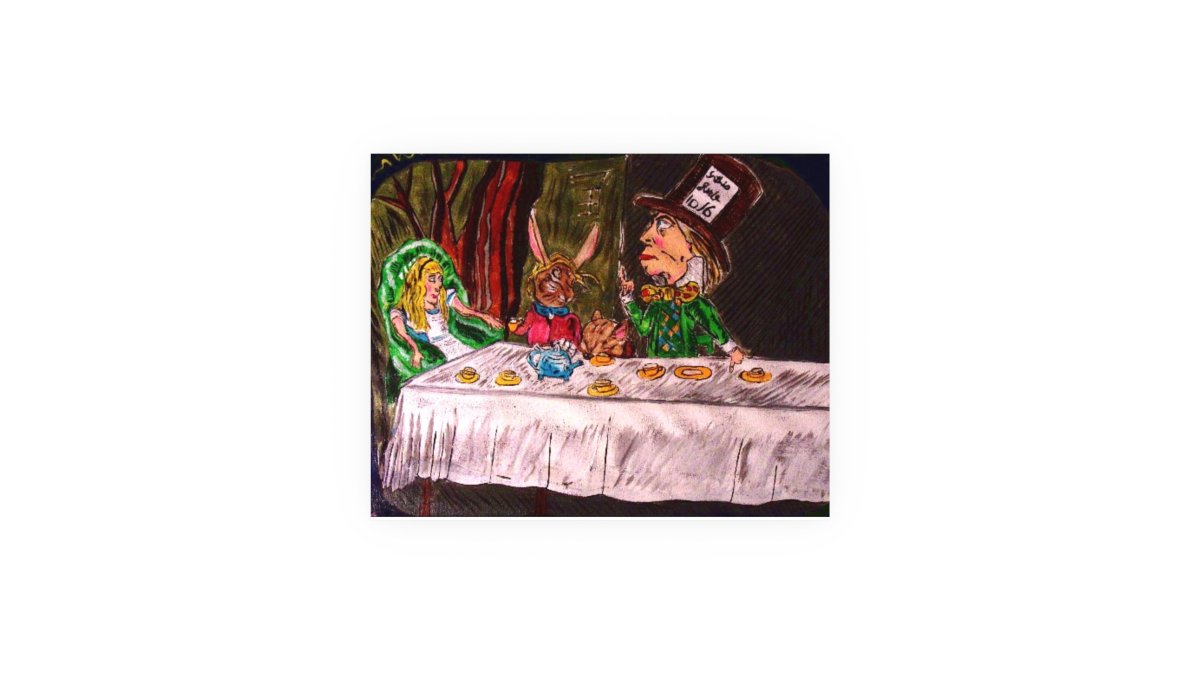
Alice in Wonderland Tea Party Poster
The Alice in Wonderland Tea Party Poster gathers curious characters around a linen-covered table, rendered in saturated inks and warm tones. It reads like a page torn from a well-loved storybook, with playful costume details and a textured background that rewards slow looking. Available in satin (210 gsm) or archival matte (230 gsm) across 18 sizes and three orientations, it suits a reading nook, studio, or nursery.

Mad Hatter Art Poster and Podling Print
The Mad Hatter Art Poster centers on an enigmatic, slightly weathered gentleman in a tall hat, a character who looks like he stepped out of a midnight fairytale. Satin stock gives the colors a luminous sheen; archival matte softens glare and deepens the moody tones. The podling takes a different route, framing a warmly lit robed figure in deep indigo and jewel tones, with brushstrokes that feel handcrafted.
Alice in Wonderland Tea Party Poster →


| Character Focus | Paper Options | Best For | |
|---|---|---|---|
| Alice Tea Party Poster | Ensemble cast, gathering scene | Satin 210 gsm / Matte 230 gsm | Reading nooks, nurseries |
| Mad Hatter Art Poster | Single enigmatic figure | Satin 210 gsm / Matte 230 gsm | Gallery walls, living rooms |
| Podling Print | Solitary robed character | Satin 210 gsm / Matte 230 gsm | Studios, above a sofa |
Fable-Inspired Wall Decor: Choosing Prints That Match Your Tale
Fable-inspired wall decor works best when the print's subject matter connects to something personal. Rather than buying a generic fantasy scene, match the tale to the room's purpose and the viewer's own history with the story. The practical problem is that most shoppers do not know what categories to search. The framework below sorts character-driven prints into five types, each with a different narrative job.
The Five Types of Character-Driven Prints
1. Sequential or panel prints. Two or more frames showing the same character at different moments. The story lives in the gap between panels, which the viewer fills in. Best for hallways and stairwells, where the eye moves anyway. This is the closest a print gets to a comic strip, and it is the type most often overlooked by buyers searching for 'narrative art.'
Matching Print Type to Room and Reader
Start with the theme you want the room to carry, then pick the type that delivers it. A tale about curiosity suits a study or home office, and the symbolic or allegorical type carries that theme without needing a caption. A story about homecoming suits an entryway, where a mythological or threshold figure reads as a welcome. A story about companionship suits a living room, where an ensemble scene gives guests something to talk about.
How to Style Narrative Art in Your Home
Styling narrative art comes down to giving the character room to breathe. Crowd it with competing decor and the story gets lost; isolate it and the figure becomes the focal point of the room.
Gallery Walls, Reading Nooks, and Modern Spaces
For a gallery wall, group prints by shared palette rather than shared size, and let one character-driven piece anchor the arrangement. In a reading nook, hang the print at eye level from a seated position so it sits inside your field of view while reading. Modern interiors handle whimsical work better than most people expect: a thin black or natural oak frame keeps the piece from reading as nursery decor, and a single large print outperforms a cluster of small ones.
Paper Finish and Print Quality: What Collectors Should Know
Paper weight and finish decide whether a print looks like art or a poster. Satin at 210 gsm gives colors a subtle sheen and slightly higher contrast, which suits vivid character work with strong highlights. Archival matte at 230 gsm produces a softer, museum-like surface that reduces glare and emphasizes fine linework, the better choice for rooms with bright windows or overhead lighting.
Frequently Asked Questions
What type of art prints tell a story through characters?
Narrative art prints that feature recognizable figures in a scene tell stories through characters. Look for prints where a character's pose, expression, and surroundings suggest action or emotion, like a Mad Hatter print or a tea party scene. Figurative art with contextual details, such as props or settings, gives viewers visual cues to interpret a narrative arc without needing text.
How do I choose fable-inspired wall decor that matches a specific tale?
Start by identifying the fable or story that matters to you, then look for prints featuring its key characters in a defining moment. Check that the artwork's color palette and mood match your space. Satin finishes make colors pop for lively tales, while archival matte suits quieter, more contemplative scenes.
Can character-driven art prints work in a modern apartment?
Yes. Character-driven prints work in contemporary spaces when you balance them with clean lines and neutral walls. A single whimsical print above a minimalist sofa becomes a focal point rather than clutter. Choose a consistent frame color, like black or natural wood, and keep surrounding decor simple. The contrast between a storybook character and modern furniture often creates the most memorable gallery walls.
What is the difference between decorative art and narrative art?
Decorative art prioritizes pattern, color, and visual pleasure without implying a story. Narrative art uses characters, setting, and compositional elements to suggest a sequence of events or an emotional arc. A floral abstract is decorative; a print of a character mid-journey through a forest is narrative. Both have a place in home decor, but narrative prints invite viewer interpretation and repeated looking.