
Table of Contents
- Why Storybook Illustrations Belong on Your Walls
- How We Chose These 6 Storybook Illustrations
- 1. Alice in Wonderland Tea Party: A Whimsical Gathering
- 2. The Coachman and the Donkey: Bold Painterly Color
- 3. Ello the Worm: Playful Character Design
- 4. Vintage Snow White: A Lantern-Lit Moment
- 5. Lampwick: Vintage Cartoon Charm
- 6. Aesop's Fable: A Secret Garden Scene
- Frequently Asked Questions
Last Updated: September 7, 2026
Why Storybook Illustrations Belong on Your Walls
Storybook illustrations are more than just pictures from familiar tales; they are a direct line to the nostalgia and wonder of childhood reading. In a world of mass-produced abstract prints, a single framed piece of character-driven art can anchor a room with personality, turning a generic living space into a narrative-rich environment. These 6 unique storybook illustrations for framing at home offer a way to bring curated, literary warmth into your daily space.
Most wall decor fades into the background, but a well-chosen illustration invites conversation and slow looking. Whether you are furnishing a nursery, a reading nook, or a modern living room, the right piece bridges the gap between playful whimsy and sophisticated interior design. Below, we’ll show you exactly how these specific prints, drawn from classic tales, can transform your walls, and we will cover the practical framing and styling choices that make them shine. But first, here is what most guides get wrong: they treat the art and the framing as separate decisions, when in reality, the paper finish and the matting are what elevate a good print into a gallery-worthy focal point.

How We Chose These 6 Storybook Illustrations
These pieces were selected based on a blend of visual storytelling, artistic technique, and their ability to complement modern home aesthetics. Each print had to pass a simple test: does it look like a page from a classic book, but feel at home in a contemporary setting? The focus was on variety in composition, color palette, and origin to ensure there is a piece for every style, from bold painterly color to delicate line work.
Prints that feature strong foreground and background elements translate beautifully to matting and framing. A deep background invites the eye in, while a distinct foreground character creates the anchor needed for a successful gallery wall. Each of the following illustrations offers a unique artistic perspective, ensuring a collection feels curated rather than random.
What You Are Actually Framing: Original, Print, or Download
Before you buy or frame any storybook art, you need to know which of three categories it falls into. This determines both the legal rules and the physical quality of what you are hanging.
1. Original vintage book pages. If you own a physical vintage book, you can carefully remove a page and frame it. This is legal for personal use, you own that physical copy. The paper is often thin, yellowed, and brittle, so it requires special handling: use a conservation-grade mat, never attach the page directly to a backing board, and keep it out of direct light. The texture and age marks are part of the charm, but they also mean the page is fragile.
2. Public domain downloads. Classic illustrations from books published before 1929 are in the public domain in the United States (copyright.gov). You can download high-resolution scans from the Library of Congress, the New York Public Library Digital Collections, or the Internet Archive. These are free to use and print for personal projects. The catch is that most scans are not print-ready, they need color correction and resolution checks before you send them to a print shop.
3. Licensed prints from contemporary artists. Many of the illustrations in this article are original works by living artists who have licensed the characters or reimagined classic tales. These are copyrighted. You are buying a license to display the print in your home, not the right to reproduce it or sell copies. Framing a licensed print is fine; scanning it and printing your own copy is not.
Why This Distinction Matters for Your Wall
The most common mistake is someone buying a "vintage-style" print online and assuming it is a faithful reproduction of a public domain image. In reality, many sellers on marketplaces take public domain scans, add digital filters, and sell them as "restored" prints. The result is often a low-resolution file that looks pixelated when printed at 18x24 inches.
The test: Before buying any print, check the resolution. A quality print should be at least 300 DPI (dots per inch) at the size you plan to frame (printingforless.com). For an 18x24-inch print, that means the source file should be at least 5400 x 7200 pixels (adobe.com). If the listing does not state the resolution, ask the seller directly.
The Sourcing Standard We Applied
For the six illustrations in this guide, three filters were applied:
- Print-ready resolution, every piece is available at a resolution that holds up at standard framing sizes.
- Archival paper options, each print can be produced on acid-free, archival-grade paper rather than standard poster stock.
- Clear licensing, each piece comes with a personal-use license that explicitly permits home framing and display.
This is the difference between a print that looks sharp on your wall and one that looks like a blurry photocopy from three feet away. It is also the difference between a piece you can legally display and one that could create headaches if you ever try to sell your home with the art included.
A Note on Character Rights
Some classic storybook characters, like Alice, Pinocchio, and Snow White, have complex copyright histories. The original books may be public domain, but specific Disney film versions are not. If an illustration looks like it came from a movie rather than a book, it is likely still under copyright. When in doubt, stick to illustrations that clearly come from the original book editions or from contemporary artists who have created their own interpretations. This keeps your wall both legal and unique.

1. Alice in Wonderland Tea Party: A Whimsical Gathering
This hand-drawn scene captures the cozy, slightly eccentric energy of a storybook tea party, rendered in saturated inks and warm tones. The composition draws you into a textured background where curious characters gather around a linen-covered table, making it perfect for a nursery or a reading corner where imagination is encouraged. The playful details in the costumes and the inviting atmosphere make it a print that rewards close inspection.

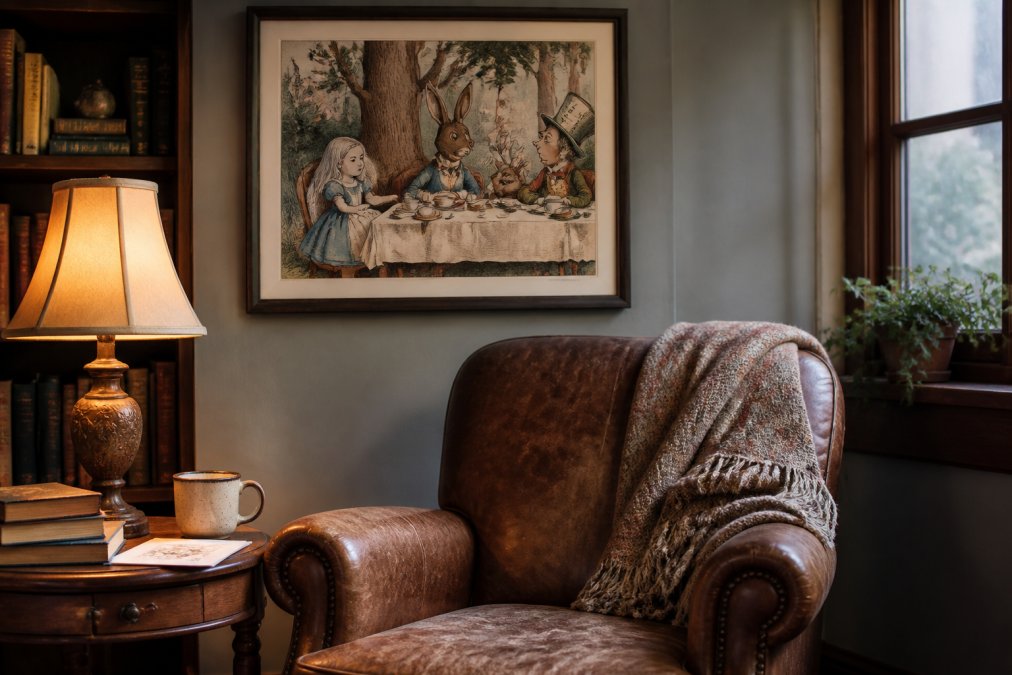
For this piece, we recommend the satin finish to lift the colors and give the scene a subtle, storybook sheen. This is a versatile print that works beautifully as a standalone statement or as the anchor of a themed gallery wall.
2. The Coachman and the Donkey: Bold Painterly Color
If you want a piece that commands attention, this illustration delivers bold, painterly color with deep shadows and rich reds that feel alive on the wall. The visual storytelling here is strong, capturing a moment of playful mischief between the coachman and his donkey that feels both nostalgic and fresh. The thick, confident brushstrokes give it the texture of a fine art painting rather than a simple print.
This is the ideal choice for a living room or studio where you want to add an artful, slightly nostalgic mood. Because the colors are so vibrant, it pairs well with a minimalist frame that lets the artwork do the talking. Consider the archival matte finish here to honor the painting’s texture and reduce glare, making the brushwork the star of the show.
3. Ello the Worm: Playful Character Design
Bringing a burst of color and personality, this quirky character wrapped in a bright blue coat and red scarf feels like a moment captured from an imaginative storybook. The playful character design is perfect for a child’s room or a creative workspace, injecting a sense of joy and whimsy that is hard to find in standard decor. With feathery blue hair and cheerful red glasses, Ello is a conversation starter that appeals to art lovers of all ages.
The textured background and painterly strokes give the image warmth, while the vibrant printing preserves every bold hue. This print shines when paired with simple, modern framing that contrasts with its whimsical subject, proving that character art can absolutely work in a contemporary space. It is a prime example of how storybook illustrations can be both playful and design-forward.
4. Vintage Snow White: A Lantern-Lit Moment
This piece captures a warm, lantern-lit interior where a young woman opens a door to animals gathered at her feet, rendered in rich, giclée color that captures deep ambers and shadowed details. The composition is masterful, using the light source to create a focal point that draws the eye through the foreground and into the mysterious background. It feels like a page torn from a well-loved vintage storybook, offering a sense of quiet wonder.
This print is ideally suited for a cozy reading nook or a rustic kitchen where its folk-tale charm can warm the space. For this piece, the textured archival fine art paper is a standout choice, as it adds a painterly depth that standard posters lack. It is a sentimental artwork that bridges the gap between children's literature and high-quality home decor.
5. Lampwick: Vintage Cartoon Charm
This vibrant, gallery-style poster brings playful color and vintage cartoon charm to any wall, with rich, saturated hues that pop while maintaining fine detail. The artwork captures the relaxed, mischievous energy of the character, rendered in bold, confident brushstrokes and moody, saturated tones that feel distinctly retro. It is a lively focal point that invites a nostalgic smile, perfect for a cozy living room nook or a creative studio.
The satin option gives a subtle sheen that enhances color intensity, making the illustration feel glossy and new. This piece appeals to collectors of retro animation art and anyone who loves bold, hand-drawn illustrations. When framing, a thicker frame profile works well here to support the weight of the bold colors and give it a substantial, collectible feel.
6. Aesop's Fable: A Secret Garden Scene
Closing our list is a vibrant art poster that brings a pocket of wild, whimsical energy into any room, with lush green stalks arching toward a warm, sunlit sky. Hidden creatures peep through the leaves, creating a playful, slightly mysterious atmosphere that sparks curiosity in both children and adults. The saturated, layered colors feel like a small, secret garden painted on paper, adding a fresh, botanical element to the collection.
This piece is perfect for a child's room, a sunroom, or anywhere you want to add a touch of cottagecore charm. It demonstrates how storybook illustrations can incorporate natural elements and composition to create a calming yet engaging visual. The matte finish is an excellent choice here to soften the reflections and emphasize the delicate, painterly details of the hidden creatures.
| Best Finish | Ideal Location | Framing Style | |
|---|---|---|---|
| Alice Tea Party | Satin | Nursery / Reading Nook | Light, solid mat |
| Coachman & Donkey | Archival Matte | Living Room / Studio | Minimalist frame |
| Ello the Worm | Satin | Kids Room / Office | Modern, simple |
| Vintage Snow White | Fine Art Paper | Cozy Nook / Kitchen | Textured, rustic |
| Lampwick | Satin | Living Room / Den | Thick profile |
| Aesop's Fable | Archival Matte | Sunroom / Playroom | Light wood frame |
How to Style a Gallery Wall with Storybook Art
The key to a cohesive gallery wall is finding a common thread, whether that is a consistent frame color, a similar matting style, or a unifying color palette across the prints. Mixing the bold painterly color of The Coachman with the delicate line work of Aesop's Fable creates a dynamic tension that feels curated. Start by laying the frames on the floor to plan your arrangement before putting any nails in the wall.
Framing Tips for Character-Inspired Wall Art
When framing these archival-quality prints, always use acid-free matting to prevent yellowing over time, and consider UV-protective glass to keep the vibrant colors from fading in direct sunlight. The choice between an archival matte and satin print often depends on the room’s lighting; matte reduces glare in bright spaces, while satin adds a luminous pop in darker corners. These simple framing techniques ensure your storybook illustrations remain a cherished part of your home for years, protecting your investment in high-quality art.
Frequently Asked Questions
What are the best paper types for framing character-inspired art?
For character-inspired art like storybook illustrations, choose between satin and archival matte paper. Satin (210 gsm) adds a subtle sheen that makes colors pop, ideal for vibrant scenes. Archival matte (230 gsm) offers a museum-quality, glare-free finish that preserves painterly detail. If your wall gets direct light, archival matte reduces reflections. Both are heavyweight and durable, so your choice comes down to whether you prefer glossy color intensity or a soft, texture-honoring finish.
Are archival matte prints better for framing than satin finishes?
Archival matte prints are often the safer choice for framing because they eliminate glare under gallery lighting or bright windows. The matte surface softens reflections and emphasizes brush-like detail, which suits painterly storybook art. Satin prints deliver a luminous sheen that intensifies color contrast but can catch light at certain angles. For a cohesive gallery wall with varied lighting, archival matte keeps the visual field calm and consistent across all pieces.
How do I protect framed storybook illustrations from sunlight damage?
Use UV-protective glass or acrylic when framing storybook illustrations to block fading rays. Hang pieces away from south-facing windows or direct afternoon sun. Choose archival matte paper, which resists light damage better than standard glossy stocks. Rotate artwork seasonally if it hangs in a bright room. These steps keep colors vivid for decades, preserving the detail in character-driven art.
How do I choose the right frame for vintage storybook illustrations?
Match the frame to the illustration's era and palette. For vintage storybook art with warm ambers and deep shadows, choose dark wood or antique gold finishes. For whimsical, colorful scenes, a simple black or white frame lets the art lead. Use acid-free matting to create breathing room and prevent the print from touching the glass. Keep the frame profile slim so the illustration remains the focal point of your gallery wall.
How can I create a cohesive gallery wall using storybook prints?
Start with a unifying element: matching black frames, consistent white matting, or a shared color palette across prints. Arrange pieces on the floor first to test spacing, keeping 2-3 inches between frames. Mix sizes and orientations for rhythm, anchoring the largest piece at eye level. Storybook art from different tales works together when the illustration style and paper finish stay consistent across the wall.
Choosing to decorate with storybook illustrations is a move toward a more personal and imaginative home. Mind Eracing Studio curates each of these character-inspired designs to ensure you are getting a distinctive piece that captures the essence of classic tales, available in high-quality satin and archival matte print options to suit your space. Add one of these prints to your collection and give your walls a story worth telling.