
Table of Contents
- Why Realistic Fantasy Art Prints Belong on Your Wall
- Where to Buy Realistic Fantasy Art Prints: Six Standout Picks
- Archival Matte Fantasy Prints vs. Satin: Which Finish Lasts?
- Character-Inspired Home Decor That Fits Modern Rooms
- Independent Fantasy Artist Marketplaces Worth Your Money
- How to Spot Authentic Artist Prints Before You Buy
- Sizing, Framing, and Hanging Your Fantasy Art Print
- Conclusion: Start Your Collection with Confidence
- Frequently Asked Questions
Last Updated: September 25, 2026
Why Realistic Fantasy Art Prints Belong on Your Wall
Realistic fantasy art prints turn a blank wall into a story. If you have been searching for where to buy realistic fantasy art prints, the best pieces rarely come from a big-box marketplace. They come from studios that curate their own catalogue and print on paper worth framing.
The difference shows up in the details. A print on heavyweight stock holds its color and its mood.
Below, we break down six standout pieces, explain how to tell an authentic artist print from a cheap reproduction, and show you how to size, frame, and hang your first one. The Library of Congress preservation guidance on paper and light exposure is a useful reference if you want to understand why paper weight and light matter over time.
Where to Buy Realistic Fantasy Art Prints: Six Standout Picks
Mind Eracing Studio is our top pick for realistic fantasy art prints because every piece is printed on your choice of satin (210 gsm) or archival matte (230 gsm) paper and assembled in the USA. The catalogue stays tight and character-driven, and each print ships in 18 sizes with horizontal, vertical, and square orientations.
Here is how the six pieces compare at a glance:
| Palette | Best For | Price | |
|---|---|---|---|
| Gothic Castle Art Poster | Crimson, black, white | Hallways, focal walls | $16.27 |
| Dragon Portrait Poster | Blues, greens, red | Reading nooks, studios | $16.27 |
| Mythic Bull and Unicorn | Crimson, indigo | Living rooms, galleries | $16.27 |
| The Faun | Deep blue, ember gold | Creative spaces | $16.27 |
| Surreal Landscape Poster | Indigo, green | Gallery walls | $16.27 |
| Fantasy Night Skyline | Indigo, moonlit blue | Bedrooms, nooks | $16.27 |
Gothic Castle Art Poster: Red Landscape with Flying Dragons
Deep crimson skies and sharp black silhouettes make this the most cinematic piece in the lineup. Hung above a couch or in a narrow hallway, it becomes a focal point.

The satin finish gives the reds a luminous pop. The archival matte keeps tones rich without glare.
Dragon Portrait Poster: Dark Fantasy Satin/Matte Wall Art
A luminous creature in deep blues, greens, and flashes of red seems to glow from within the paper. This is the pick for a reading nook or studio where you want something unsettling and magnetic.
Mythic Bull and Unicorn Art Poster: Surreal Fantasy Print
A small, luminous unicorn faces a towering, flame-backed beast across crimson and indigo. It works as a focal piece above a couch or in a moody gallery wall.
The Faun: Mythic Wall Art for Moody Rooms
Deep blues and inky blacks frame ember-gold hair and horned silhouettes. It reads like a fragment of a myth and holds up in quiet rooms or creative spaces where you want the wall to do the talking.
Archival Matte Fantasy Prints vs. Satin: Which Finish Lasts?
Archival matte is a low-glare finish built for long-term color stability and a museum-style texture. Satin is a lightly coated finish that adds a soft sheen and deepens color saturation. Which you choose depends on the room, not on which is "better."
- Choose archival matte for rooms with strong windows, overhead lighting, or any space where glare would wash out the image. The 230 gsm weight gives it a substantial, gallery-ready feel.
- Choose satin for dim rooms, hallways, or anywhere you want the colors to lift. The 210 gsm stock carries a subtle sheen that makes reds and deep blues feel brighter.
For a hallway with no natural light, satin wins. For a sun-drenched living room, archival matte protects the image and your eyes.
Dust both finishes with a clean, dry cloth. No sprays, no damp rags.
Character-Inspired Home Decor That Fits Modern Rooms
Character-inspired home decor works in a modern room when you treat the print as the one loud element and keep everything around it quiet. Pairing a dark fantasy poster with busy patterns, heavy drapes, and cluttered shelving makes the art compete instead of anchor.
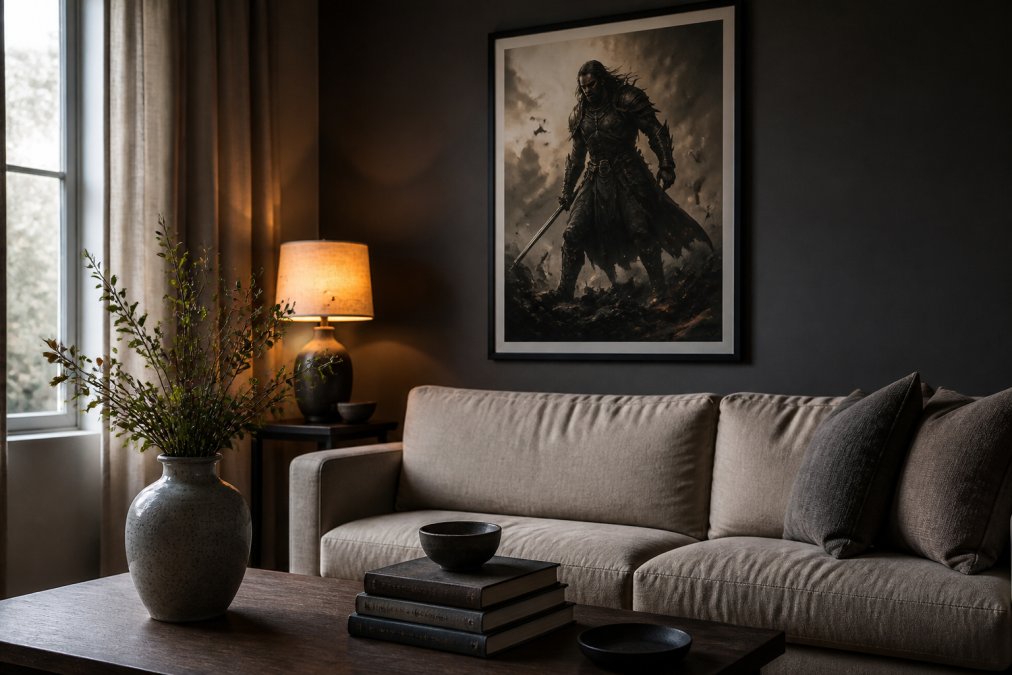
The formula that works:
- Neutral base. Linen, oatmeal, or charcoal upholstery.
- One dark anchor. A single poster with deep indigo or crimson tones.
- Warm light. A lamp at 2700K keeps the mood without washing out the print.
- Two textures. Ceramic, wood, or wool to soften the graphic punch.
This is where a character-driven piece beats a generic landscape. A dragon or a faun gives the room a narrative. A beige abstract gives it nothing to talk about.
Independent Fantasy Artist Marketplaces Worth Your Money
Independent fantasy artist marketplaces are platforms where individual studios sell their own work directly, rather than acting as a warehouse for thousands of unrelated sellers. That distinction matters because the platform you choose determines who controls the file, the paper, and the shipping.
Here is how the major channels actually differ:
-
Artist-run storefronts (Shopify, Squarespace, Big Cartel). The artist controls the file, paper spec, and fulfillment. Big Cartel's free tier caps at five products; paid tiers run roughly $10 to $30 per month.
-
Print-on-demand marketplaces (Redbubble, Society6, Fine Art America). The platform prints and ships; the artist uploads a file. Selection is enormous, but paper stock varies and the artist never touches your print. Fine Art America publishes its paper and canvas options on each listing, making it one of the more transparent POD options.
-
Curated art marketplaces (Etsy, Artfinder). Etsy is a mixed bag: some sellers are studios with stated gsm specs, others are drop-shippers reselling the same scraped file. Artfinder vets applicants and skews toward original and limited-edition work.
-
Artist collectives and studio sites. Smaller, harder to find, and usually the best paper specs. These are the sellers who publish a gsm number without being asked.
-
Are the paper weights stated in gsm?
-
Is the print assembled domestically or drop-shipped from overseas?
-
Does the listing show the actual file resolution or pixel dimensions?
-
Is there a stated return window, and who pays return shipping?
-
Can you see the artist's other work as a coherent collection?
-
Does the seller disclose whether the file is theirs or licensed?
One more money-saving filter: check whether the seller offers the same image in multiple size tiers with a stated maximum print size. A file that tops out at 18 by 24 inches is a different product than one that scales to 36 by 48.
How to Spot Authentic Artist Prints Before You Buy
A quick side-by-side: a mass reproduction typically arrives on 150 to 170 gsm stock, shows visible softness at arm's length on anything over 18 inches, and carries no stated file resolution. A studio print arrives on 200 gsm or heavier stock, holds detail at 24 inches and up, and comes with a paper spec the seller will repeat in writing. The price difference is a few dollars; the difference on the wall is years.
Sizing, Framing, and Hanging Your Fantasy Art Print
Sizing starts with the wall, not the print. Measure the width of the furniture below the wall, then aim for artwork spanning roughly two-thirds to three-quarters of that width. A 72-inch sofa wants a print or gallery grouping in the 48 to 54 inch range.
Framing notes:
- Matte prints look best with a thin black or natural wood frame and a white mat.
- Satin prints can go frameless on a float mount if the room is dim.
- Gallery walls work best with an odd number of pieces and consistent spacing of 2 to 3 inches.
Conclusion: Start Your Collection with Confidence
The hardest part of collecting is trusting that what arrives matches what you saw on screen. That gap between listing photo and living room wall is where most online art purchases go wrong.
Frequently Asked Questions
Where can I buy high-quality fantasy art prints directly from artists?
Small studio shops like Mind Eracing Studio sell directly, so you know who printed the piece. Look for stated paper weights (210 gsm satin or 230 gsm archival matte), US printing, and a clear return policy. Direct-from-artist fantasy art prints usually start around $16.27 for poster sizes.
What is the difference between archival matte and satin art prints?
Archival matte fantasy prints use a 230 gsm paper with a low-glare, textured surface that resists fading and keeps brushwork visible. Satin runs 210 gsm with a soft sheen that deepens color and adds a subtle glow. Choose matte for bright rooms or gallery walls; choose satin for moody spaces where you want the blues and reds to pop.
How do I choose the right size fantasy art print for my wall?
Most studio posters come in 18 sizes across horizontal, vertical, and square formats, so you can match a narrow hallway or a wide bedroom wall.
How can I ensure my fantasy art prints are durable and fade-resistant?
Check the paper weight and finish before buying. Archival matte at 230 gsm holds color longer than thin poster stock, and keeping prints out of direct sunlight slows fading. Dust with a clean dry cloth only.