
Table of Contents
- Start With Your Fairy Tale Vision
- How to Write an Art Commission Brief That Gets Results
- Find the Right Artist for Your Fairy Tale Style
- Budget, Pricing, and the 70/30 Deposit Rule
- How Long Does an Art Commission Take?
- Commissioning Art Etiquette and Best Practices
- Get the File Specs and Usage Rights Right
- Your Custom Fairy Tale Art Checklist
- Frequently Asked Questions
Last Updated: September 9, 2026
Commissioning custom fairy tale art is the process of hiring an artist to create an original, personalized illustration based on a classic story, fable, or character that holds personal meaning for you. This guide walks through every step, from the first sketch to the final print, so you can avoid the miscommunications that derail most commissions.

Start With Your Fairy Tale Vision
Every successful commission begins with a clear sense of what you want to see on your wall. Before contacting any artist, decide which tale, characters, and specific moment feel most meaningful. In the fairy tale genre, vision means more than picking a princess and a dragon, light, color, and symbolic objects tell the viewer this is a storybook world.
Ask yourself what emotional tone you want the finished piece to carry. A dark, gothic rendering of a castle at midnight creates a completely different atmosphere than a bright, whimsical tea party scene. The U.S. Copyright Office guidance on visual art protects the final expression of an idea, not the idea itself, so the more specific your vision, the more the artist can deliver a piece that feels personal rather than generic.

Fairy Tale Visual Tropes to Specify in Your Brief
A fairy tale specialist will tell you to describe the atmosphere through concrete visual cues. Consider which of these tropes you want your artist to lean into:
- Lighting as mood: Deep indigo twilight with a single warm lantern glow suggests mystery and impending adventure. Golden hour sunlight filtering through a forest canopy reads as nostalgic and safe. Cool moonlight with sharp shadows edges toward gothic or eerie. Name the time of day and the light source explicitly.
- Magical atmosphere markers: Glowing dust motes, floating fireflies, soft halos around characters, or shimmering heat-haze effects all signal "magic is present" without a single wand needing to appear. If you want the art to feel enchanted rather than merely illustrative, ask for one of these atmospheric devices.
- Character archetypes and silhouettes: Fairy tale characters often read through silhouette before detail. A hunched figure with a long cloak and crooked staff says "witch" instantly; a tall, straight-backed figure in a crown reads as royalty. Tell your artist which archetype each character belongs to so they can exaggerate the right physical cues.
- Storybook borders and decorative frames: Many classic fairy tale illustrations, from Arthur Rackham to Kay Nielsen, are framed by intricate borders of vines, thorns, stars, or architectural flourishes. If you want that authentic storybook feel, request a decorative border in the brief. This is a decision that affects composition, so it must be made before the sketch phase.
- Symbolic objects: A single red apple, a spinning wheel, a trail of breadcrumbs, or a glass slipper carries narrative weight. Decide whether you want these objects foregrounded, backgrounded, or hidden as easter eggs for viewers who know the tale.
Sketch rough notes on the composition, characters, and color palette. Collect reference material from paintings, films, or childhood copies of the story. This mood board becomes the foundation of your brief and saves hours of back-and-forth later.
Decide how literally you want the tale retold: the traditional Brothers Grimm ending, a Disney-influenced softened version, or a personal twist where characters resemble your family. Fairy tales are public domain, so artists can freely depict any version, but the version you choose changes character design, costume, and tone. Name the era and cultural reference point so the artist does not default to a generic aesthetic.
How to Write an Art Commission Brief That Gets Results
An art commission brief tells the artist exactly what you want, including subject matter, medium, composition, and intended use. A strong brief prevents costly revisions and keeps the project on schedule.
Start with the story and the specific scene. Name the tale, characters, and moment you want captured. Then describe the composition in simple terms: "The princess stands left of center, reaching toward a unicorn on a ridge, with a wizard observing from the foreground shadows." Include your preferred color palette and any visual tropes you love.
State the intended use up front. Is this for personal enjoyment in your living room, or do you plan to reproduce it on products? This distinction matters for pricing and for the usage rights you will need to negotiate.
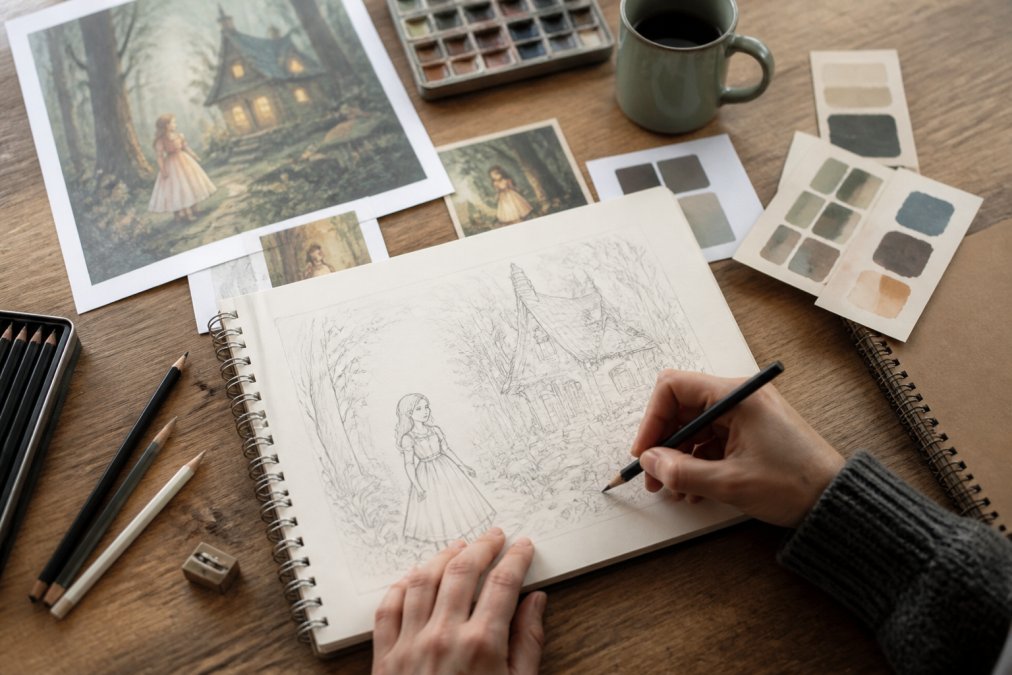
A complete brief also covers logistics: canvas size or aspect ratio, medium, and deadline. Many artists publish their own commissioning guidelines, so review those before you send yours.
Find the Right Artist for Your Fairy Tale Style
The best artist for your project is someone whose existing portfolio already demonstrates the visual style you want, not a talented generalist who will have to stretch. Fairy tale art spans a huge range, from dark gothic illustration to soft, nostalgic watercolor, so match the artist's aesthetic to your vision.
Browse portfolios on art marketplaces, social media, and personal websites. Look for artists who regularly paint the same medium and subject matter you want. Check their commission pages for current availability and pricing. A common mistake is falling in love with an artist's style only to discover they no longer take commissions.
Send a short inquiry with your completed brief attached. Ask about their typical process, whether they offer a sketch phase for approval, and how many revisions are included in their quoted price. This conversation reveals their communication style before you commit.
Budget, Pricing, and the 70/30 Deposit Rule
Commission pricing varies widely based on the artist's experience, medium, composition complexity, and usage rights. A simple black-and-white ink drawing costs far less than a fully rendered, multi-character digital painting with commercial licensing.
A widely used payment structure is the 70/30 rule: you pay 70 percent upfront to secure the artist's time, with the remaining 30 percent due upon final delivery. Many artists instead ask for a 50 percent deposit, so confirm the exact split before you agree. The deposit is standard practice and protects the artist from canceled projects.
Your budget should also account for print costs if you intend to hang the piece. High-quality giclée prints on archival paper or canvas cost more than standard poster printing but preserve the artist's color and detail. Mind Eracing Studio offers prints on satin and archival matte paper, with character-inspired designs drawn from classic tales.

| Payment Stage | Typical Share | What It Covers |
|---|---|---|
| Deposit (upfront) | 50-70% | Artist's time, initial sketches, reserved slot |
| Milestone payment | Optional | Approved color study or refined sketch |
| Final payment | 30-50% | Finished artwork, high-res files, usage rights |
How Long Does an Art Commission Take?
A typical custom art commission takes two to eight weeks from initial sketch to final delivery, depending on medium, the artist's workload, and how quickly you respond to revision requests. Complex oil paintings or highly detailed digital scenes sit at the longer end of that range.
After you pay the deposit, the artist shares a sketch or composition study within one to two weeks. You review it, request changes, and approve the direction. The artist then completes the finished piece, which can take another one to four weeks, and delivers the high-resolution files or ships the physical artwork.
Build buffer time into your schedule. If you need the art for a specific date, such as a birthday or anniversary, tell the artist at the inquiry stage. Many artists charge rush fees for accelerated timelines, so expect to pay more if you need the work in under two weeks.
Commissioning Art Etiquette and Best Practices
Commissioning art etiquette is the set of professional norms that keeps the working relationship respectful and productive, from how you give feedback to how you handle the payment schedule.
Respond to artist messages promptly, especially during the sketch and revision phases. Delays on your end push back the entire timeline. When you request a change, be specific: "The dragon feels too small" is actionable; "I don't like it" is not.
Respect the artist's creative process and stated boundaries around artistic liberty. You are hiring them for their visual expertise, so trust their judgment on composition and color unless something directly contradicts your brief.
If you dislike a direction the artist has taken, return to the written brief and point to the specific line that was missed. A well-documented brief turns subjective opinions into objective checkpoints.
Get the File Specs and Usage Rights Right
Before you make the final payment, confirm exactly what files you will receive and what you are legally allowed to do with them. Usage rights determine whether you can hang the piece at home, share it on social media, or use it commercially. This is where most fairy tale commissions go sideways, the buyer assumes "I paid for it, so I own it" and the artist assumes "I sold a print license, not my copyright."
Personal Use vs. Commercial Licensing: The Fairy Tale Book Problem
For personal use, most artists grant you the right to display the artwork in your home and share it online with proper credit. This covers nursery decor, a living room gallery, or a framed gift. But fairy tale art has a unique complication: it is frequently commissioned for projects that blur the line between personal and commercial.
Consider these scenarios that trigger commercial licensing:
- Self-published children's books: If you are illustrating a retelling of a classic tale for a book you plan to sell on Amazon or at local book fairs, that is commercial use. You need a licensing agreement that covers print runs and distribution.
- Printed products for resale: Greeting cards, mugs, t-shirts, or prints you sell at craft markets all require commercial rights.
- Business branding: A bakery or daycare using your fairy tale art on its website, signage, or marketing materials is commercial use, even if the business is small.
- Fundraisers or charity auctions: Selling prints of the artwork to raise money, even for a good cause, is generally treated as commercial use because money changes hands.
For commercial use, you will need a separate licensing agreement, usually at a higher fee. The fee scales with the scope: a single print run of 100 copies costs less than unlimited digital distribution. The Graphic Artists Guild's pricing and ethical guidelines provide a useful reference for industry-standard licensing terms. Most artists retain copyright to their work unless they explicitly transfer it, which is rare and expensive. What you are buying is permission to use the image in specific ways.
File Specifications: DPI, Color Profiles, and Formats
File specifications matter if you plan to print the artwork yourself. Generic guides say "ask for a high-resolution file" without explaining what that means in practice. Here is the technical breakdown you need:
Resolution (DPI): Ask for 300 DPI at your intended print size. A file that is 300 DPI at 8x10 inches is 2400x3000 pixels. If you want a 16x20 inch print at 300 DPI, you need 4800x6000 pixels. If the artist delivers a file that is only 150 DPI at your print size, it will look soft and pixelated when printed. Check the pixel dimensions in the file properties before you accept delivery.
Color profile: Digital screens display in RGB (red, green, blue). Commercial printers use CMYK (cyan, magenta, yellow, black). If the artist delivers an RGB file and you send it to a print shop without conversion, the colors will shift, often becoming duller or muddier. Ask for a CMYK-converted file if you are printing commercially, or ask the artist to deliver both RGB and CMYK versions. For fine art giclée prints, many print shops accept RGB files and handle conversion themselves, but confirm with your printer first.
File formats: For print, request TIFF or high-quality PNG. TIFF is lossless and preferred by professional print shops; PNG also works well. JPEG files use compression that degrades quality, especially if the file has been saved multiple times. Avoid accepting a final delivery as a JPEG unless it is a high-quality (low compression) file at full resolution. For digital use only, social media, a website, or a digital frame, a high-resolution JPEG or PNG at 72 DPI is sufficient, but you should still request the full-resolution original for archival purposes.
Physical artwork vs. digital files: If you commissioned a physical painting, confirm whether the artist includes a high-resolution digital scan or photograph of the finished piece. Many artists charge extra for this, but it is essential if you ever want to reproduce the art as prints. Negotiate this at the start, not after the painting is shipped.
A Practical Delivery Checklist
Before you make the final payment, confirm the following in writing:
- File format (TIFF, PNG, or high-quality JPEG)
- Resolution in DPI at your stated print size
- Color profile (RGB, CMYK, or both)
- Whether a physical original is included or ships separately
- Usage rights scope (personal display, social media sharing, commercial reproduction, print run limits)
- Whether the artist provides a license document or contract addendum
If you prefer not to commission at all, a curated collection like Mind Eracing Studio's offers ready-made, character-inspired prints from classic tales in satin and archival matte finishes. The American Society of Media Photographers' guide to usage rights explains why licensing terms matter for any artwork you acquire, whether commissioned or purchased as a print.
Your Custom Fairy Tale Art Checklist
Commissioning custom fairy tale art goes smoothly when you treat it like a small project with clear deliverables. The U.S. Small Business Administration's guide to writing a creative brief recommends documenting every expectation in writing, which applies equally to art commissions.
- Define the story, characters, and specific scene you want illustrated
- Gather 5+ reference images for mood, palette, and composition
- Write a complete brief including subject, medium, size, and deadline
- Research artists whose portfolios match your desired visual style
- Confirm the artist's process, revision policy, and current availability
- Agree on the payment schedule and deposit amount in writing
- Review and approve the sketch phase before full rendering begins
- Confirm the file format, resolution, and print-readiness before final payment
- Secure usage rights in writing for personal or commercial use
- Plan for framing or printing that preserves the artwork's quality
The most common commission failures stem from vague briefs and unclear usage terms. A specific vision, a written agreement, and a realistic timeline will get you a piece you will treasure for years. If you want storybook art without the commissioning process, explore Mind Eracing Studio's curated prints of classic tales, available in satin and archival matte finishes to match your space.
Frequently Asked Questions
What should be included in a commission brief for custom art?
A strong brief for commissioning custom fairy tale art includes the specific tale or fable, the characters and scene you envision, the mood and color palette, the medium you prefer, and the intended use (personal or commercial). Reference images are helpful. Define your budget and desired timeline upfront. The more detail you provide about the composition and aesthetic, the better the artist can align their artistic process with your vision.
How long does a typical art commission take?
The timeline for an art commission depends on the artist's schedule, the medium, and the piece's complexity. A detailed character illustration can take anywhere from 2 to 8 weeks from the initial sketch phase to final delivery. The artist should provide a timeline with milestones for sketches, revisions, and the final piece. Always ask about their current workload before signing a contract.
What is the 70/30 rule in commissioning art?
The 70/30 rule is a common payment structure where you pay a 70% deposit upfront and the remaining 30% upon final delivery. The upfront payment covers the artist's time and materials and secures their commitment to your project. This is standard practice and protects the artist from investing hours in a project that might be canceled.
What are the legal considerations for copyright on commissioned art?
Unless a contract states otherwise, the artist retains copyright to their artwork. If you commission a piece for commercial use, such as a book cover or product, you need a written agreement that transfers usage rights or grants a specific license. For personal use, you typically receive the right to display the art, but the artist can still use it in their portfolio. Always clarify these terms before the project begins.
Commissioning original art is a rewarding process, but it demands clear communication, a realistic budget, and attention to the technical details of files and rights. Mind Eracing Studio understands that desire for character-driven, storybook decor, which is why we offer curated, colorful posters and prints from classic tales in both satin and archival matte options. Add a piece that captures your favorite fable and brings a touch of whimsy to your walls.