
Table of Contents
- Step 1: Pick a Spot and Plan Your Reading Nook
- Step 2: Choose Seating That Supports Long Reading Sessions
- Step 3: Find the Best Lighting for Reading Nooks
- Step 4: Add Affordable Wall Art for Book Lovers
- Step 5: Layer Textiles and Soft Furnishings
- Step 6: Organize Books and Storage Without Clutter
- Step 7: Try Small Reading Nook Ideas That Save Space
- Budget-Friendly Upgrades and Common Mistakes to Avoid
- Frequently Asked Questions
Last Updated: September 20, 2026
Step 1: Pick a Spot and Plan Your Reading Nook
A reading nook is a small, dedicated area for reading, built around one comfortable chair, good light, and a place to set a book. The best ones fit into space you already have.
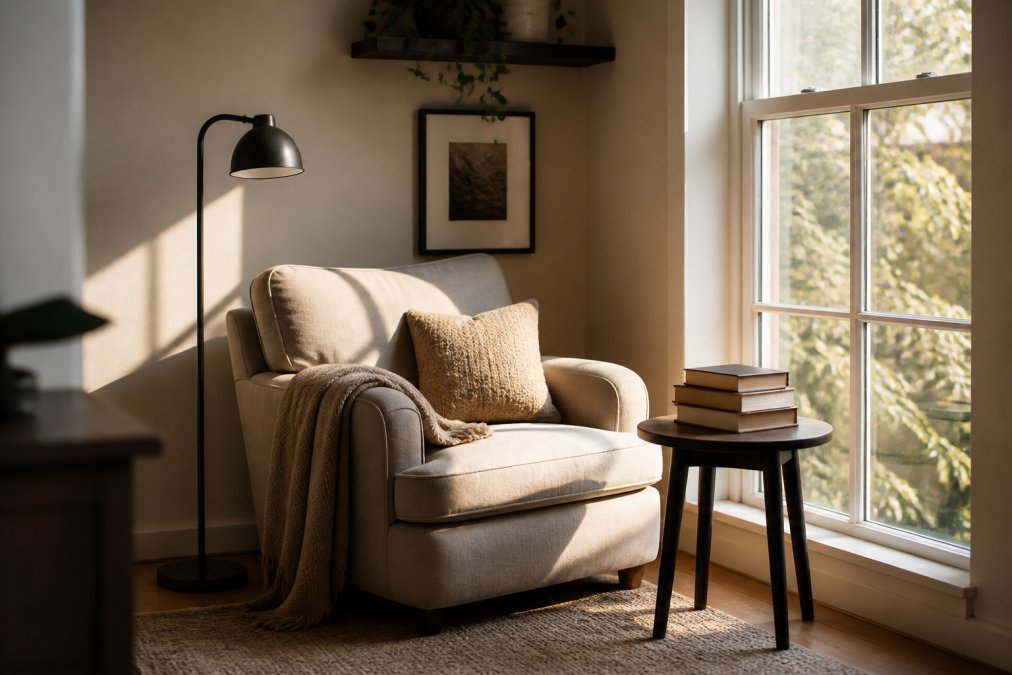
Start with these steps:
- Watch how sunlight moves through your home for one day.
- Pick a corner that gets soft light, not harsh glare.
- Measure the floor space and the wall height.
- Check for an outlet nearby for a lamp.
- Note noise sources, like a TV or a busy hallway.
Corner Use and Small Space Ideas
Corners are the most wasted space in most homes. A corner needs less furniture than a full wall, so it costs less to fill.
Try these small space ideas:
- Tuck a chair at a 45-degree angle across the corner.
- Use a narrow console or floating shelf instead of a full bookcase.
- Hang art higher to draw the eye up and make the space feel taller.
- Add a floor lamp in the dead corner behind the chair.
- Use a room divider to carve out a quiet zone in an open floor plan.
Step 2: Choose Seating That Supports Long Reading Sessions
The right reading chair supports your back for an hour or more, not just for a photo. Test any chair before you buy: sit for at least ten minutes with a book. If your lower back aches or your neck cranes forward, keep looking.
Ergonomics for Long-Term Reading
Bad posture ends reading sessions fast, so look for these traits:
- Seat height that lets your feet rest flat on the floor.
- A backrest that supports your lower back curve.
- Armrests high enough to hold a book without shrugging.
- Firm cushioning that does not sink after twenty minutes.
Step 3: Find the Best Lighting for Reading Nooks
The best lighting for reading nooks combines one bright task light with one soft accent light. Two sources beat one every time; a single ceiling light casts shadows on the page and tires your eyes.
Task Lighting and Accent Lighting Basics
Task lighting is focused light aimed at your book or hands; accent lighting is softer light that warms the whole nook. Set up both:
- Place a task lamp beside your shoulder, not in front of your face.
- Aim the beam at the page, not at your eyes.
- Use a warm bulb, around 2700K to 3000K, for a calm glow.
- Add a small accent lamp or a string of soft lights behind the chair.
- Put both lights on a dimmer so you can adjust as evening comes.
The Numbers That Actually Matter
Here is what to check on the box:
- Brightness: Aim for roughly 400 to 600 lumens at the page for comfortable reading. A standard 60-watt-equivalent LED puts out about 800 lumens, often too much for a small nook unless it is dimmable.
- Color temperature: 2700K to 3000K reads as warm and calm. Anything above 4000K feels clinical and can suppress the relaxed mood you want.
- Color rendering (CRI): Look for CRI 90 or higher. A high-CRI bulb makes book covers, art prints, and wood tones look true instead of muddy.
- Beam angle: A narrow beam (around 30 to 40 degrees) focuses light on the page. A wide flood beam spills light into your eyes.
Fixing Glare Without Buying Anything
Glare is the real enemy of long reading sessions, and it comes from three places:
- A glossy page under a direct beam. Angle the lamp so light hits the page at a slant, not straight down.
- A bright window behind the book. Move the chair so the window is to your side, not behind your head or behind the page.
- A bare bulb in your line of sight. Add a shade or move the lamp behind your shoulder line.
Layering Light Like a Designer
Three layers make a nook feel intentional:
- Ambient: a dimmable ceiling or wall fixture for general fill.
- Task: the focused lamp at your shoulder.
- Accent: a small lamp, candle-style bulb, or string light behind the chair to add depth.
For a full breakdown of bulb types and placement, see U.S. Department of Energy lighting guides.
Step 4: Add Affordable Wall Art for Book Lovers
Affordable wall art for book lovers starts with one strong piece, not a full gallery wall. One good print anchors the whole nook.
Satin vs. Archival Matte Prints
Satin paper has a subtle sheen that deepens color. Archival matte paper has a textured, museum-style finish that softens glare.
Pick based on your light:
- Bright room with direct sun: choose archival matte to cut glare.
- Dim room with warm lamps: choose satin to lift the colors.
- Mixed light: matte is the safer pick for reading comfort.
Step 5: Layer Textiles and Soft Furnishings
Textiles do the emotional and acoustic work in a reading nook: they add warmth, cut echo, and make a hard chair feel inviting, quietly solving the sound problem most guides ignore.
Layer in This Order
- A washable throw blanket over the chair back.
- One or two throw pillows for back and arm support.
- A small area rug to define the space and warm bare floors.
- A floor cushion if you like to read low sometimes.
- A basket for blankets you want within reach.
Keep colors to two or three tones. Too many patterns fight each other and make a small nook feel cramped.
How Textiles Quiet a Room (the Part Most Guides Skip)
Hard surfaces, drywall, wood floors, glass, bounce sound; soft surfaces absorb it. That is why a "cozy" room feels calmer: you are reducing reflected sound, not just adding decoration. You do not need acoustic panels, just mass and surface area. Ranked by impact per dollar:
- A thick area rug with a pad. This is the single biggest win on a hard floor. Aim for a rug large enough that all four chair legs sit on it, a too-small rug looks like a bath mat and does almost nothing acoustically.
- Heavy curtains. A floor-length curtain panel absorbs more than a short valance. If you already have blinds, add one curtain panel on the noisiest side.
- An upholstered chair or a slipcover. Fabric over foam absorbs mid and high frequencies, exactly the range of a TV or a conversation in the next room.
- A bookshelf with books on it. Irregular, dense surfaces scatter sound. A full shelf is a free acoustic diffuser.
- A throw over a hard chair back. Small effect, but it also stops the chair from feeling cold against your back.
Fabric Choices by Season
A nook you adjust twice a year stays useful all year. The swap costs nothing if you already own the pieces:
- Cool months: wool or flannel throw, a heavier rug, velvet or corduroy pillows. These trap warmth and absorb more sound.
- Warm months: linen or cotton throw, a flat-weave or jute rug, lighter pillow covers. These breathe and keep the nook from feeling stuffy.
Sizing and Care Basics
- Rug: measure so the rug extends at least 6 inches past the chair on the sides you walk past. A 3-by-5-foot rug fits most single-chair nooks; a 5-by-8 works if you add a footstool.
- Throw: a 50-by-60-inch throw covers your lap and shoulders without dragging the floor.
- Pillows: two 18-inch squares fit most armchairs. One behind the lower back, one at the side.
- Washability: choose machine-washable covers for anything that touches your face or hands. A nook you actually use will need washing more often than a display room.
Step 6: Organize Books and Storage Without Clutter
A reading nook needs books nearby, but clutter kills the calm. Aim for one shelf of current reads, not your whole collection.
Try these storage moves:
- Use a floating shelf at eye level for the books you are reading now.
- Store the rest in a closed cabinet or a lidded basket.
- Keep a small tray on the side table for a mug and a bookmark.
- Rotate your shelf every season so it stays fresh.
Step 7: Try Small Reading Nook Ideas That Save Space
Small reading nook ideas work best when one piece of furniture does two jobs, saving floor space and money.
Options that fit tight spots:
- A storage bench with a cushion on top.
- A repurposed ladder as a blanket and book rack.
- A window seat built over existing radiators or low cabinets.
- A hanging chair that uses ceiling space instead of floor space.
- A fold-down desk that doubles as a journaling space.
DIY Reading Tent and Canopy Options
A DIY reading tent or canopy turns a corner into a hideaway, suiting kids' rooms and adult nooks alike.
Simple builds to try:
- A hula hoop hung from the ceiling with sheer fabric draped over it.
- A curtain rod in a corner with two panels tied back.
- A teepee frame made from five wooden dowels.
- A canopy over a daybed using a wall bracket.
Budget-Friendly Upgrades and Common Mistakes to Avoid
Cheap wins that pay off:
- Swap a harsh bulb for a warm, dimmable one.
- Add a footstool for better leg support.
- Hang one large print instead of several small ones.
- Move the chair away from a noisy doorway.
| Mistake | Fix | Why It Matters |
|---|---|---|
| One ceiling light only | Add a task lamp and accent light | Cuts glare and eye strain |
| Chair chosen for looks | Test-sit for ten minutes first | Supports long reading |
| Whole book collection on display | Rotate one shelf of current reads | Keeps the nook calm |
| No soft textiles | Add a throw, pillow, and rug | Warms the space and cuts echo |
| Art picked last | Choose one focal print early | Anchors the whole design |
Two angles most guides skip are sound and season. For sound, a thick rug, a bookshelf, and heavy curtains absorb noise on a budget. For seasons, swap a wool throw for linen in summer and rotate art to match the light.
Frequently Asked Questions
What are the essentials for a cozy reading nook?
A comfortable chair with back and arm support, a dedicated light source like a floor lamp or wall sconce, and a small surface for a drink or book. Add a throw blanket and one or two character-inspired art prints to give the corner personality. You do not need much square footage; a 3-by-3-foot corner can work if the seating and lighting are right.
How do you make a reading nook in a small space?
Use vertical space and corners. A wall-mounted shelf keeps books off the floor, a slim floor lamp replaces a bulky table lamp, and a folding chair or repurposed bench fits tight footprints. Room dividers can carve out a quiet zone in a shared room. Affordable wall art for book lovers also adds character without taking up any floor space.
What kind of lighting is best for a reading nook?
You want two layers: a task light positioned over your shoulder or beside the page, and a softer accent light for ambiance. A floor lamp with an adjustable arm works well because you can angle it toward the book and away from your eyes. Warm bulbs around 2700K to 3000K reduce glare and eye strain during long sessions.
How do you style a reading nook with wall art?
Hang one larger statement print at eye level when seated, roughly 8 to 12 inches above the chair back, or group three smaller prints in a vertical column if wall space is narrow. Character-driven art from classic tales adds a storytelling mood that plain decor cannot. Satin paper deepens color; archival matte softens glare near a lamp.
Building a literary reading nook on a budget takes a corner, a chair you have tested, and two light sources. That is it. Mind Eracing Studio makes the finishing step simple with character-inspired art prints drawn from classic tales, available on satin or archival matte paper starting at $16.27 and printed in the USA. Add one print above your chair and the corner stops being empty space. Get started with Mind Eracing Studio and turn your reading corner into a space you actually use.