
Table of Contents
- What Makes an Art Print Archival?
- The Giclée Print Lifespan: What to Expect
- Archival vs. Non-Archival Paper: Why It Matters
- How to Protect Art Prints from Fading
- Framing and Storage: Materials That Extend Print Life
- Testing Print Longevity: Accelerated Aging and Real-World Data
- Conclusion
- Frequently Asked Questions
Last Updated: September 12, 2026
What Makes an Art Print Archival?
Archival art prints use pigment-based inks on acid-free, lignin-free paper, so the image resists fading and yellowing for decades under proper display and storage. At Mind Eracing Studio, every poster is printed on 210gsm satin or 230gsm archival matte stock.

Three variables decide how long an archival art print lasts: the ink chemistry, the paper substrate, and the environment it lives in. Change any one of them and the lifespan shifts dramatically. The Library of Congress preservation guidance on paper and ink stability treats ink type and paper purity as the two dominant factors in print degradation.
Pigment Inks vs. Dye Inks: The Core Difference
Pigment inks suspend solid color particles in a carrier liquid. Dye inks dissolve color directly into the liquid. That physical difference drives everything else.
Pigment particles sit on the paper surface and resist breakdown from light and oxygen, while dyes penetrate the coating and break down faster under UV. A pigment print on cotton rag can hold its color for generations; a dye-based poster on coated stock may shift visibly within a few years on a bright wall.
Color gamut is the trade-off. Dye inks historically produced more vivid, wider-gamut color. Modern pigment sets have closed most of that gap, which is why fine art and gallery printing moved almost entirely to pigment.
The Giclée Print Lifespan: What to Expect
Giclée print lifespan depends on the ink-and-paper pairing, not a universal number. A pigment giclée on archival matte paper, framed behind UV-filtering glazing and kept out of direct sun, commonly holds its color well over a century; the same print taped to a sunlit wall may fade within a decade.

Manufacturers publish lightfastness ratings based on standardized tests, usually expressed in years under glass or in "display life" terms. Those ratings assume ideal conditions, so treat them as a ceiling, not a guarantee. The ISO 18916 standard for imaging materials and enclosure stability defines how print enclosures are tested, which is the closest thing the industry has to a common benchmark.
| Condition | Expected Display Life | Main Risk |
|---|---|---|
| Pigment ink, archival matte, UV glazing, indirect light | 100+ years | Minimal |
| Pigment ink, archival paper, no glazing, indirect light | 40-70 years | Surface soiling, UV |
| Pigment ink, direct sunlight, no glazing | 5-15 years | Rapid fading, color shift |
| Dye ink, coated stock, bright room | 2-10 years | Fading, paper yellowing |
Archival vs. Non-Archival Paper: Why It Matters
Archival paper is acid-free, lignin-free, and neutral pH, so it will not degrade from the inside. Non-archival paper contains lignin and acidic sizing that yellow and embrittle over time, no matter how good the ink is.
The paper is often the weak link: a pigment print on newsprint-grade stock can still fail early.
Acid-Free and Lignin-Free Substrates
Lignin is a wood-pulp polymer that oxidizes and yellows, and acidic sizing accelerates that process. Archival substrates remove both.
Common archival substrates include cotton rag, alpha-cellulose, and coated papers engineered to neutral pH. Optical brighteners can also degrade and cause color shift, so conservation-grade papers often minimize them.
- Cotton rag: highest stability, textured surface, best for fine art
- Alpha-cellulose: smooth, bright, good for photographic reproduction
- Coated archival matte: balances color accuracy and stability
How to Protect Art Prints from Fading
Protecting art prints from fading means controlling four factors: light, humidity, temperature, and airborne pollutants. Light gets the most attention, but climate is the variable most collectors ignore, it quietly destroys paper from the inside even when the print never sees direct sun.
Display Conditions: Light, Humidity, and Temperature
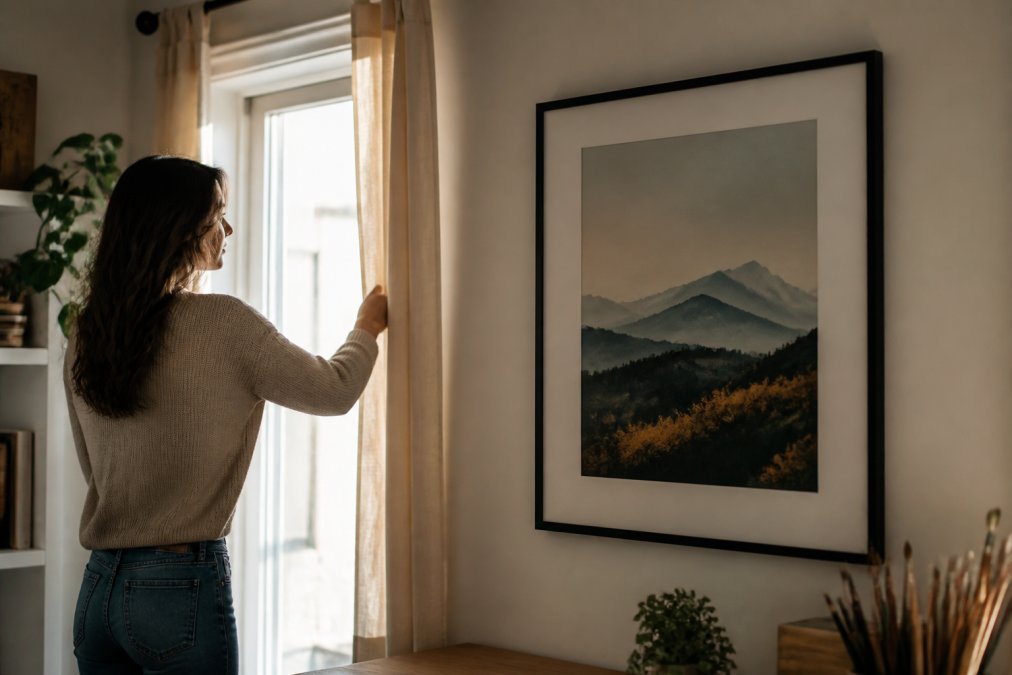
Ultraviolet light is the primary driver of fading and color shift, and even visible light degrades pigments cumulatively, a print does not recover when the lights go off. Keep prints out of direct sun, avoid placing them opposite unshaded windows, and use UV-filtering glazing. LED bulbs emit far less UV than halogen or fluorescent sources, making a lighting swap one of the cheapest protective moves available.
Humidity and temperature interact. Paper is hygroscopic, it absorbs and releases moisture, so when relative humidity swings, the sheet expands and contracts, stressing fibers, causing cockling, and opening pathways for acids and pollutants. Sustained humidity above roughly 65% invites mold and foxing; below about 30% makes paper brittle and prone to edge cracking.
The National Park Service museum collections guidance on environmental monitoring describes the same stable temperature and humidity ranges used in museum storage. The practical target for a home or studio is a stable range rather than a perfect number: roughly 60-70°F with relative humidity held between 40% and 50%, and, critically, as little fluctuation as possible. A print held at a steady 55% RH fares better than one oscillating between 30% and 70% every week.
HVAC systems are double-edged: central air stabilizes temperature and pulls moisture from the air, but registers aimed at a wall create hot, dry microclimates that accelerate embrittlement. Keep framed prints off exterior walls, away from supply vents, and out of bathrooms, kitchens, and basements where humidity spikes.
Airborne Pollutants and Off-Gassing
Light and climate are not the only threats. Ozone, sulfur compounds, and volatile organic compounds (VOCs) oxidize pigments and paper. Ozone is a particular problem in urban areas and near certain appliances, attacking colorants in both dye and pigment inks and causing measurable fading even in dark storage.
Off-gassing is the indoor version: fresh paint, new carpet, particleboard furniture, and cleaning solvents release VOCs that migrate into framed artwork. That is why conservation framing uses inert, sealed backing, and why prints near a freshly painted wall should be moved until the paint cures.
- Keep prints away from kitchens, garages, and rooms with strong chemical odors
- Avoid displaying near photocopiers, laser printers, and air purifiers that generate ozone
- Let new paint, carpet, and furniture off-gas for several weeks before hanging nearby
- Use sealed frame backs to limit pollutant ingress
Rotate and Store to Extend Display Life
Even in a well-controlled room, light exposure accumulates. Rotating prints on your brightest walls every few months spreads that exposure across your collection. Prints that come off the wall should go straight into dark storage, not sit out in a lit room.
Framing and Storage: Materials That Extend Print Life
Framing materials can either protect a print or damage it. The wrong backing board, adhesive, or mat can cause acid burn and staining within a few years.
Use these materials when framing:
- Acid-free mat board and backing, never standard cardboard
- UV-filtering glazing, either glass or acrylic
- Photo corners or archival hinges, never spray adhesive or double-sided tape
- A sealed frame back to keep dust and insects out
Dark storage is the other half of the equation: prints stored flat, interleaved with acid-free tissue, in a cool, dry, dark place outlast the same prints on display. That is why collectors keep a portfolio in dark storage and rotate pieces onto walls.
Mounting adhesives are a frequent point of failure: rubber cement, spray mount, and standard tape contain acids or solvents that migrate into paper. Conservation mounting uses starch paste or archival hinging tape that reverses without damage.
Testing Print Longevity: Accelerated Aging and Real-World Data
Accelerated aging is how the industry estimates print life without waiting a century: expose a print to intense light, heat, and humidity in a lab, measure how fast it degrades, then extrapolate to normal display conditions. The extrapolation is where the uncertainty lives.
How Lightfastness Testing Actually Works
Lightfastness testing measures color change under controlled illumination: a sample is exposed to a known light intensity for a set period, and a spectrophotometer reads its color values before and after to calculate the shift.
The industry standard is the Blue Wool Scale, eight blue-dyed wool samples that fade at known, progressively slower rates. A print is rated by comparing its fading to the wool. A rating of 6 or higher is generally excellent for fine art; 1-3 indicates noticeable fading in a normal room.
Manufacturers convert lab exposure into a "display life" figure by assuming a light level, commonly around 450 lux, roughly a well-lit living room, and hours per day. Change either assumption and the number changes, which is why two manufacturers can test the same ink-and-paper combination and publish figures differing by decades.
Thermal Aging and the Arrhenius Approach
Light is only one degradation pathway. Paper also breaks down through oxidation and acid hydrolysis, driven by heat and moisture rather than photons. Thermal aging tests simulate those reactions by storing samples at elevated temperatures and measuring loss of strength, rising acidity, or yellowing.
The extrapolation often uses the Arrhenius equation, which describes how reaction rates increase with temperature, a common rule of thumb is that a 10°C (18°F) rise roughly doubles a reaction rate. Run a sample at elevated temperature for a few weeks, apply the equation, and you get an estimate of decades at room temperature.
The catch: the Arrhenius model assumes a single dominant reaction, while real paper degrades through several simultaneous pathways, so it can overstate or understate life. Treat thermal aging figures as a comparative tool for ranking papers, not a literal countdown clock.
Reading a Manufacturer's Longevity Claim
A published lifespan figure is only as good as its assumptions. When you see a claim like "200 years," ask what was tested and under what conditions.
| What the claim says | What it usually means |
|---|---|
| "100+ years" with no detail | Marketing language; no test conditions disclosed |
| "Lightfastness rating of 7 on the Blue Wool Scale" | Specific, comparable, and verifiable |
| "Tested under glass at 450 lux, 12 hours/day" | A defined display scenario you can sanity-check |
| "Wilhelm Imaging Research display permanence rating" | An independent third-party test with published methodology |
Wilhelm Imaging Research is the best-known independent lab in this space. Its ratings specify the ink, paper, display conditions, and framing assumptions, making them far more useful than a bare number, when a seller cites one, they are citing a test you can look up.
What This Means for Buyers
The practical takeaway: look for prints that state a specific ink type and substrate, not just the word "archival." Naming pigment inks and acid-free paper is a verifiable claim; "archival quality" with no detail is marketing language.
Mind Eracing Studio prints on both satin and archival matte stock, and matte is the choice when longevity is the priority: it is engineered to neutral pH with minimal optical brighteners, removing two degradation pathways accelerated aging tests are designed to catch.
Conclusion
How long archival art prints last depends on decisions made at the press and on your wall. A pigment print on archival matte paper, framed with UV glazing and kept out of direct sun, can hold its color for generations; the same print hung in a bright window will not.
Choosing prints that are actually built to last means looking past vague "archival" labels and checking the ink and paper specs. Mind Eracing Studio prints every design on 210gsm satin or 230gsm archival matte stock, with matte as the choice for collectors who want maximum longevity, and offers 18 sizes with horizontal, vertical, and square framing options. If you want character-driven art that is made to stay vivid on your wall, start with the Satin and Archival Matte Posters and pick the matte finish for the long haul.
Frequently Asked Questions
What makes an art print considered archival?
An archival art print uses acid-free, lignin-free paper and pigment-based inks. These materials resist yellowing, fading, and degradation. Museum-quality prints also have a neutral pH and may include a protective coating. Combined, these features give the print a display life of decades or even over a century under proper conditions.
Do archival prints fade over time?
All prints fade eventually, but archival prints fade far slower. Pigment-based inks and acid-free paper can resist noticeable fading for 80 to 200 years when framed with UV-filtering glazing and kept out of direct sunlight. Non-archival prints may show color shift in as little as 5 to 10 years.
How can I extend the life of my art prints?
Display prints away from direct sunlight and high humidity. Use UV-filtering glazing and acid-free mounting materials. Keep temperatures stable between 60 and 75°F. For long-term storage, place prints in dark, cool, dry conditions using archival sleeves. These steps can add decades to a print's display life.
Do pigment-based inks last longer than dye-based inks?
Yes. Pigment-based inks contain solid color particles that sit on the paper surface and resist UV light and moisture. Dye-based inks dissolve into the paper and break down faster. A pigment print on archival paper can last over 100 years, while a dye print may fade noticeably in under 20 years.