
Table of Contents
- Why Proper Lighting Matters for Your Art Collection
- Best Color Temperature for Art Lighting
- How to Avoid Glare on Framed Art
- Art Lighting Placement Guide: Position and Spacing
- Types of Lighting Fixtures for Art Displays
- Balancing Natural and Artificial Light
- Protecting Your Art: UV Exposure and Heat Dissipation
- Smart Home Integration and Budget-Friendly Solutions
- Frequently Asked Questions
Last Updated: September 30, 2026
Why Proper Lighting Matters for Your Art Collection
Good lighting transforms how art looks on your wall. Bad lighting makes even beautiful pieces look flat, washed out, or impossible to see clearly. The difference between these outcomes comes down to a few key decisions about brightness, color, and placement.
Your art deserves light that shows off its colors, protects it from damage, and creates the mood you want in your space. Whether you're hanging character-driven prints from Mind Eracing Studio or any other artwork, understanding the best lighting techniques for home art displays makes all the difference.
Most collectors overlook lighting until after hanging pieces, then struggle with glare, shadows, or mismatched colors. The fix requires understanding a few core principles, not expensive equipment.
Best Color Temperature for Art Lighting
The color of your light matters as much as its brightness. Color temperature measures how warm or cool light appears, rated in Kelvin (K). Warm light (2700K-3000K) feels cozy. Cool light (4000K-5000K) feels crisp and clinical.
For art, aim for 3000K to 4000K, this range shows colors naturally without yellow or blue shifts.
Color Rendering Index (CRI) measures color accuracy. Look for CRI 90 or higher; below 80 makes colors look dull or distorted.
Modern LEDs with high CRI run cooler and last longer than incandescent or halogen bulbs, making them ideal for valuable pieces.
How to Avoid Glare on Framed Art
Glare is the enemy of framed art. It bounces off glass and prevents you from seeing the image clearly. The solution involves both light placement and the right glass choice.
The 30-degree rule: Position light at a 30-degree angle from the wall to bounce light away from your eyes. If you see reflection in the glass, adjust the angle.
Matte glass eliminates most reflection problems, upgrade from standard glass when reframing.
Move lights farther from the wall: 3 feet away creates softer, more even illumination than 12 inches away.
Dimmable lights let you start low and increase brightness without hotspots or glare.
| Glare Problem | Quick Fix | Best Long-Term Solution |
|---|---|---|
| Light reflects in glass | Adjust angle to 30 degrees | Upgrade to matte glass |
| Harsh bright spot on frame | Move light farther away | Use dimmable LED fixture |
| Overall brightness too high | Lower dimmer setting | Install multiple softer lights |
| Reflection visible from seating area | Reposition light fixture | Combine angle adjustment with matte glass |
Art Lighting Placement Guide: Position and Spacing
Mastering where you place lights is central to the best lighting techniques for home art displays, determining what viewers see. Proper placement creates even illumination across the entire piece without dark corners or bright spots.
The 30-Degree Rule for Optimal Illuminance
Position lights at a 30-degree angle from the wall surface. This angle prevents glare while directing light across the entire artwork. Measure from the center of the frame and angle your light accordingly.
Mount lights slightly above the frame top, never below, to mimic natural light.
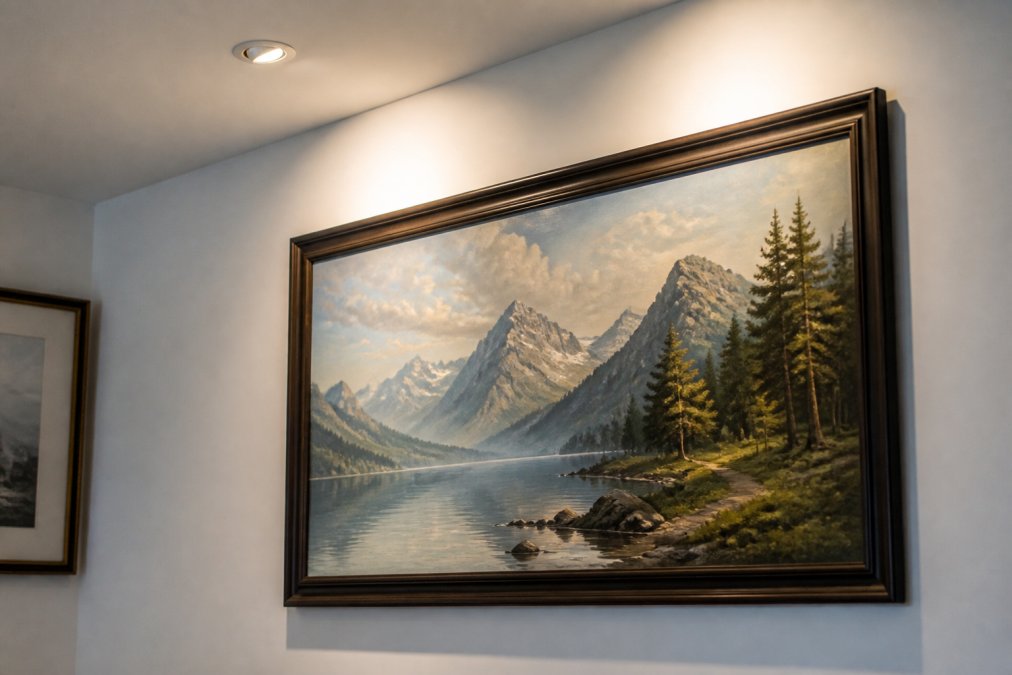
Distance from wall affects beam spread: 18 inches creates a tight beam; 3 feet spreads broadly to prevent dark edges on large pieces.
Frame Spacing and Visual Rhythm
For multiple pieces, use consistent spacing and position lights to illuminate the entire group as one composition, not individual pieces.
For gallery walls, use one larger light source to wash across the entire arrangement, creating cohesion.
Aim for 2 to 3 inches between frames; uneven spacing creates visual tension lighting cannot fix.
Types of Lighting Fixtures for Art Displays
The right fixture depends on art type, wall configuration, and permanence of installation.
Track Lighting and Recessed Accent Lights
Track lighting offers flexibility for renters and frequent rearrangers. Mount a rail to wall or ceiling, then slide lights along it without drilling new holes.
Look for track systems with:
Satin and Archival Matte Posters →
- Beam angle between 24 and 40 degrees (narrower for spotlighting, wider for wall washing)
- CRI 90 or higher on the included or compatible LED heads
- Dimmable capability via remote or wall switch
- Adjustable heads that tilt and rotate independently
Track systems cost $80-$300 for a 4-foot rail with two to three heads. Some use adhesive strips for renters, though with lower weight capacity.
Recessed accent lights mount flush for a minimalist look but require permanent in-wall wiring and professional installation. Plan placement carefully before committing.
Recessed lights work best for permanent placements where you want invisible lighting. Professional installation costs $200-$500 per fixture.
Choose recessed fixtures with adjustable trim rings. Standard 6-inch cans accept LED bulbs rated 3000K-4000K with CRI 90+. Most have a 40-degree beam for pieces 6-10 feet away.
Picture Lights and Wall Washing Techniques
Picture lights mount above frames with brackets and wall anchors (no wiring). Quality lights cost $40-$150.
Picture lights work best for individual pieces 16-40 inches wide with matte surfaces.
When selecting a picture light, check length (60-80% of frame width), adjustable arm angle, LED compatibility with CRI 90+, and finish.
Fixture Selection by Art Medium
Different art types have distinct lighting needs:
Oil paintings and acrylics benefit from 3000K light and picture lights or accent lighting. Matte surfaces diffuse light naturally; use 30-40-degree beam angles.
Balancing Natural and Artificial Light
Daylight changes throughout the day. Balancing natural and artificial light maintains consistent illumination.
Protecting Your Art: UV Exposure and Heat Dissipation
Lighting that's too close or too hot damages artwork: heat makes paper brittle, UV rays fade colors.
Smart Home Integration and Budget-Friendly Solutions
Modern lighting control is accessible and affordable. Choose based on your living situation, budget, and comfort with technology.
Smart Lighting Systems for Art Collections
Smart LED bulbs let you control brightness, color temperature, and timing from your phone, though understand what's useful versus hype.
Budget-Friendly and Renter-Friendly Alternatives
Not everyone needs or wants smart home complexity. Simpler solutions deliver 80% of the benefit at a fraction of the cost and complexity.
- Clip-on picture lights ($30-$80): Clamp to frames without drilling; works for single pieces up to 24 inches.
- Portable track rails ($80-$200): Magnetic or adhesive-mounted; removable when you move.
- Tripod lights ($40-$120): Freestanding; useful for testing placement before permanent installation.
DIY Wall Washing Without Professional Installation
Professional wall-washing costs $800-$1,500. Achieve comparable results for $150-$300 using off-the-shelf components.
Choosing Your Approach: A Decision Framework
Choose smart lighting if you want automation, have multiple displays, are tech-comfortable, and plan to stay long-term.
Choose portable/clip-on solutions if:
- You're renting and want zero permanent installation
- You're testing placement before committing to permanent fixtures
- You have a small collection or single focal piece
- You move frequently or like flexibility
Long-Term Maintenance and Upgrades
Whichever system you choose, plan for occasional maintenance and upgrades.
Frequently Asked Questions
What is the 30-degree rule for art lighting?
The 30-degree rule states that light should hit your artwork at approximately a 30-degree angle from the wall surface. This angle minimizes glare and specular reflection while ensuring even illuminance across the piece. Position your light fixture so the beam spreads across the entire artwork without creating hot spots or harsh shadows. This technique works for both accent lighting and wall washing approaches.
What color temperature is best for home art displays?
Color temperatures between 2700K and 3000K (warm white) work best for most home art displays, as they enhance color rendering without appearing artificial. For pieces with vibrant colors, 3000K to 4000K (neutral white) provides better Color Rendering Index (CRI) performance. Avoid temperatures above 5000K, which can make artwork appear clinical. Always choose LED luminaires with CRI ratings of 90 or higher to preserve the artist's intended color accuracy.
How do I prevent glare on framed art with glass?
Reduce glare by positioning lights at the 30-degree angle. Matte finishes naturally scatter light and minimize specular reflection. Use diffusing fixtures or install anti-glare glass on your frames. Dimmable LED lights let you control beam spread and intensity. Avoid placing artwork directly across from windows or bright light sources, and use wall washing techniques that spread light evenly rather than concentrating it in one spot.
Should I use LED or halogen lights for artwork?
LED luminaires are the superior choice for home art displays. They produce minimal heat dissipation, reducing UV exposure and fading risk. LEDs offer excellent color rendering (CRI 90+), adjustable color temperatures, and dimmability for precise control. Halogen lights generate excessive heat and infrared radiation, which accelerates deterioration of artwork and can damage delicate prints. LEDs also consume less energy and last significantly longer, making them cost-effective for long-term display.
Proper lighting transforms how your art looks and feels in your space. The techniques covered here work whether you're displaying character-driven prints from Mind Eracing Studio or any other artwork. Start with one quality light, position it at a 30-degree angle, and adjust until glare disappears and colors shine. From there, you can expand with additional fixtures and smart controls as your collection grows. The investment in good lighting pays dividends every time you look at your walls.